Do I need a licence to start a home business in the UAE?
Yes, if you are selling. The UAE Government portal states it plainly: "You must have the appropriate licence to conduct eCommerce activities." The governing law is Federal Decree by Law No. 14 of 2023 on Modern Technology-Based Trade, covering goods, services and data sold through websites, mobile applications, social media platforms and digital marketplaces. Selling through an Instagram account or a social media shop sits inside that definition, not outside it.
On the mainland that means a commercial licence including eCommerce activity, from your emirate's Department of Economic Development. Some emirates issue a standalone individual eCommerce licence, others fold it into a regular commercial licence, and the federal portal does not say which does which, so ask yours.
One step is easy to miss: every eCommerce licence also requires approval from the Telecommunications and Digital Government Regulatory Authority. TDRA publishes this one clearly: the no-objection certificate for practising an e-activity is free of charge and takes 2 working days, applied for with UAE Pass. You attach a commercial licence if you have one, plus no-objection certificates from the competent authorities for any restricted activities.
Once licensed, the obligations are ongoing: issue a clear digital invoice for every transaction, sell only permitted products, obtain approvals for regulated ones, and comply with data privacy rules. Licensing is your own responsibility as the owner, not something a marketplace grants or checks for you.
Which licence fits, and which emirate?
Here general advice stops being useful. Even the count of licence types is disputed: on one federal page the Ministry of Economy and Tourism says six, Abu Dhabi's department says seven, and Invest in Dubai says eight. Start with the home business licence guide, then read your emirate's own page.
Dubai
Two routes matter. Invest in Dubai describes the eTrader licence as a sole establishment licence for Dubai home-based businesses, at AED 1,070 in licence and knowledge and innovation fees plus AED 300 for Dubai Chamber membership. Intelaq costs AED 1,050 a year to issue and renew, but eligibility is narrow: 100 per cent owned and managed by UAE or GCC nationals, residence in Dubai, no more than five trade licences already held, and a no objection letter from your landlord consenting to the home being the business address.
The Intelaq page contradicts itself: the copy calls it an opportunity for "a Dubai resident", while the requirements restrict it to UAE and GCC nationals. If that gap describes you, ask Invest in Dubai before paying.
Abu Dhabi
Abu Dhabi lists a Mobdea licence for female UAE citizens only, covering 44 largely creative activities with no physical headquarters required. It also lists a Trader Licence issued electronically to citizens and residents, and a Freelancer Licence open to citizens and foreigners for practising remotely without office premises. It publishes no fee and no processing time for any of them, so ask the department before you set a budget.
Sharjah
Sharjah publishes its fees, structured unlike anywhere else. Licence issuance is a percentage of the lease contract value or area: 8 per cent for citizens, minimum AED 800, and 13 per cent for other nationalities, minimum AED 1,300. It is gated on a lease contract and a SEWA electricity deposit, and late renewal costs AED 200 a month. No page explains how a business run from home meets the lease contract basis, so ask the Sharjah Economic Development Department.
Ajman and the northern emirates
Ajman, Ras Al Khaimah, Umm Al Quwain and Fujairah publish no accessible English page for a home business licence, no fee schedule and no issue time. Treat any figure you read for them as unverified until the department confirms it.
What does each step cost, and how long does it take?
| Step | Cost | Stated time | Source |
|---|---|---|---|
| Trade name, Dubai | AED 620 | 10 minutes | Invest in Dubai |
| Trade name, Sharjah | AED 250 (translated AED 1,250, foreign AED 2,250) | 1 working day | SEDD |
| Trade name, other emirates | Not published | Not published | ADDED |
| Dubai eTrader licence | AED 1,070 plus AED 300 chamber membership | 5 minutes | Invest in Dubai |
| Dubai Intelaq licence | AED 1,050 a year, issue and renew | 5 minutes | Invest in Dubai |
| Sharjah licence issuance | 8% of lease value, min AED 800 (citizens); 13%, min AED 1,300 (others) | 1 working day | SEDD |
| Licence in Abu Dhabi, Ajman, RAK, UAQ or Fujairah | Not published | Not published | ADDED |
| TDRA no-objection certificate for e-activity | Free of charge | 2 working days | TDRA |
| Setup via the federal Basher platform | Not published | 15 minutes | u.ae |
Three warnings. Those are online transaction times, not end to end times including external approvals, and no source gives a realistic total. Once you receive a trade licence payment voucher, you have 30 days to pay it or the application is cancelled. And the Dubai figures come from archived snapshots taken between 12 December 2024 and 24 January 2025, because the live pages block access from outside the UAE, so re-confirm them before budgeting.
Tax and banking: the numbers most guides get wrong
Three figures get conflated constantly. Keep them apart.
VAT registration is mandatory once taxable supplies and imports exceed AED 375,000 over the previous 12 months, or you expect to within the next 30 days. Voluntary registration opens at AED 187,500, and that one can be met by taxable expenses as well as supplies.
Corporate tax is a different rule. Holding a sole establishment or home licence makes you a natural person, and the Federal Tax Authority says a natural person is subject to corporate tax only once turnover from business activity exceeds AED 1,000,000 in the calendar year. Below that, it says natural persons should not register. Wages, personal investment income and real estate investment income are excluded from the test. The AED 375,000 attached to corporate tax is the 0 per cent rate band on taxable income, not a registration trigger, and above it the rate is 9 per cent. That it matches the VAT threshold is coincidence.
Small Business Relief sits higher again: revenue of AED 3,000,000 or less in the current and all previous tax periods, open to a resident natural person. It must be actively elected, and a simplified return still filed on time.
On banking, no bank publishes a document checklist for a home licence holder. RAKBANK asks AED 25,000 average monthly balance on its Business Current Account, while its RAKstarter account is zero balance. Mashreq publishes minimums from AED 50,000 to AED 350,000, Wio prices by subscription from AED 99 a month, and Emirates NBD publishes no minimum at all. Compare on the balance you can hold every month.
Pricing, orders and delivery
Set a price that survives your costs
Work upward from ingredients or materials, packaging, your own time, and any fee charged on the sale, never from someone else's price. The pricing guide has the arithmetic.
Decide how customers order and pay
You can take orders in a chat thread, on a website builder such as Shopify, Squarespace, Wix, Salla or Zid, or through a marketplace. Whichever you choose, the digital invoice rule applies.
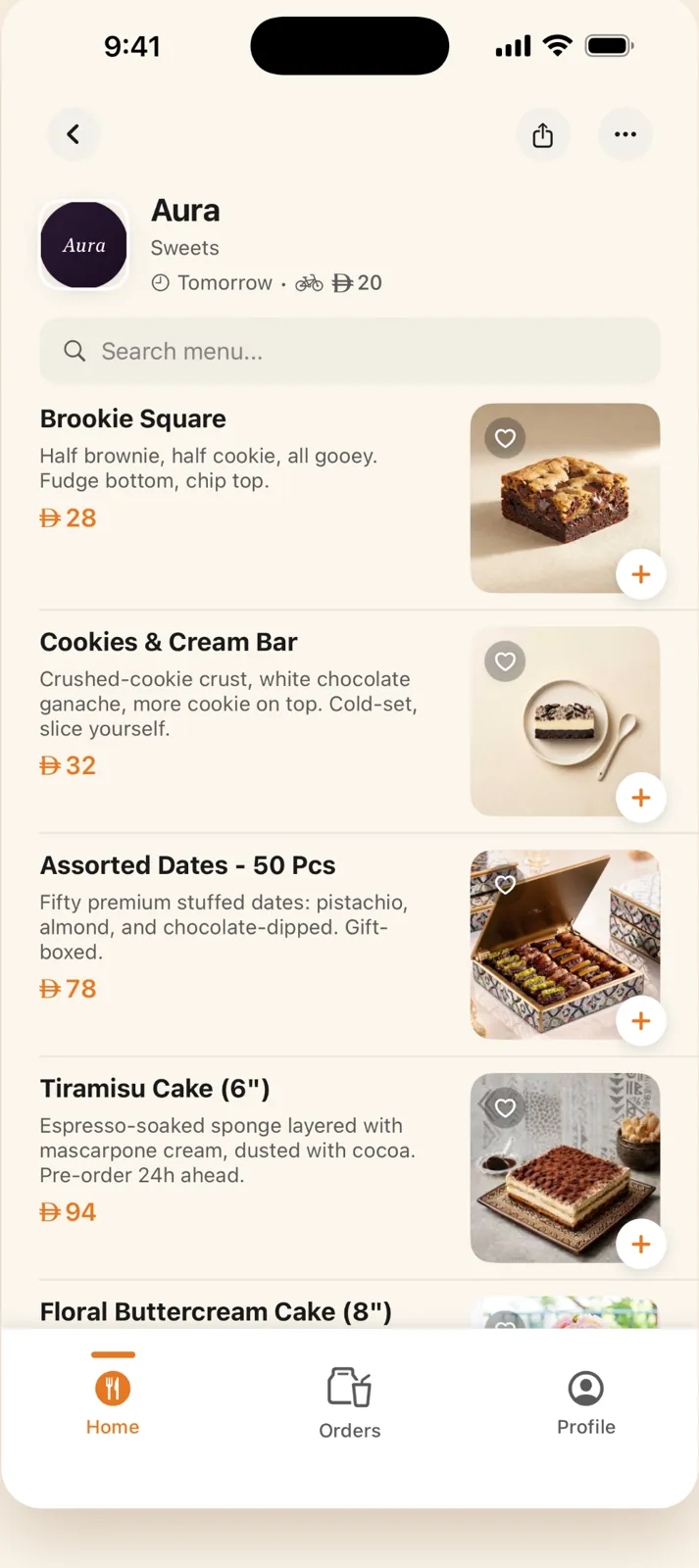
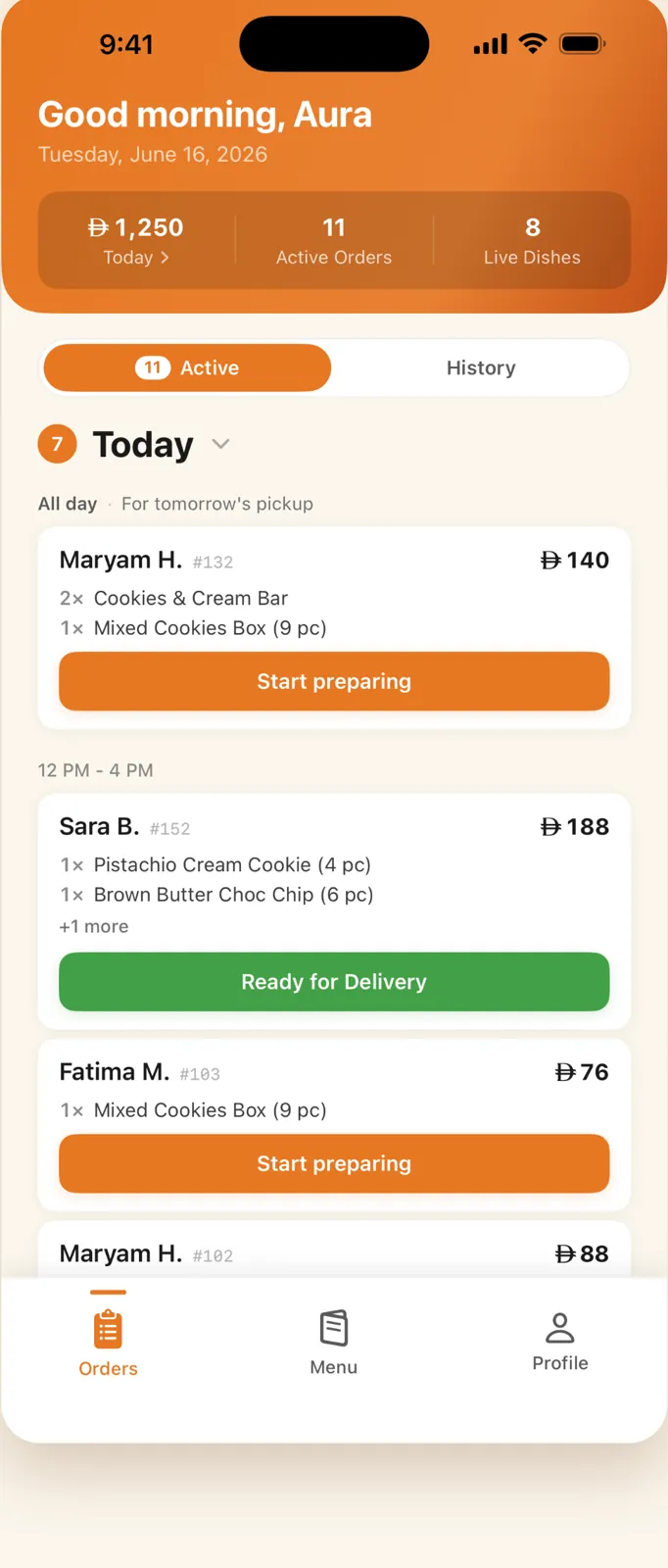
KLU is one option. It is free to join, with no listing, subscription or setup fees. You pay 5 per cent commission on completed orders plus 2 per cent card processing, and payouts land weekly in a UAE bank account. You get a storefront link to share, buyers order on iOS, Android or the web, and onboarding is in English and Arabic.
Decide how orders reach the customer
Pickup, your own drop offs, or a courier such as Quiqup or Careem. On KLU you can offer pickup or delivery, with the buyer paying the delivery fee at checkout. The delivery guide covers the trade offs.
How do I get my first customers?
Density beats reach. Sell first to people who can physically receive an order this week: your building, your street, your neighbourhood. Show the real thing, not a designed graphic, and answer every message the same day.
Frequently asked questions
Can a home licence sponsor a residence visa?
No official source answers this, for any emirate. Neither the Invest in Dubai eTrader and Intelaq pages nor Abu Dhabi's licensing page mentions visas, establishment cards or sponsorship. Dubai's instant licence does bundle a residency establishment card and a labour ministry card, and the eTrader licence carries no such statement. Ask your Department of Economic Development for a written answer.
Can I hire staff on a home business licence?
Unclear, and the federal process suggests real limits. Hiring requires a Ministry of Human Resources and Emiratisation establishment file, an electronic signature card, and a physical inspection of the establishment's facilities. The ministry sets your quota partly by "the size of the work facilities", and no source states how that applies to a residential address. Ask the ministry first.
Do I need a physical address if I work from home?
The federal portal says all UAE businesses must have a physical address and that a rental agreement must be provided. Yet Abu Dhabi lists a Freelancer Licence practised remotely with no office premises and a Mobdea licence with no physical headquarters, and Dubai's eTrader is explicitly for home-based businesses. The authorities have not reconciled this in public, so ask the department that issues your licence.
Do I need a food safety approval to prepare food at home for sale?
We could not verify this either way. The federal approvals list covers sectors such as telecoms, aviation and media, and does not address food prepared at home. Do not assume it is unnecessary. Check the current rule with your emirate's municipality or food safety authority, and with your Department of Economic Development, before taking an order.
Sources
- eCommerce, The Official Platform of the UAE Government (11 August 2026)
- No-objection certificate for practising an e-activity, TDRA (fetched 24 August 2026)
- Steps to start a business on the mainland, u.ae (16 July 2026)
- Recruiting on the mainland, u.ae
- Corporate tax, u.ae (30 March 2026)
- Registration for VAT, Federal Tax Authority (6 April 2026)
- Basis of Taxation, Natural Person, Federal Tax Authority
- Small Business Relief, Federal Tax Authority
- FTA on simplified returns under Small Business Relief
- Licensing Requirements, Abu Dhabi Department of Economic Development (24 July 2026)
- Issue Trade Name, Sharjah Economic Development Department
- Licence issuance, Sharjah Economic Development Department
- Request to book a trade name, Invest in Dubai (archived 12 December 2024)
- Request to issue a trade licence, Invest in Dubai (archived 26 December 2024)
- Request for Intelaq licence, Invest in Dubai (archived 24 January 2025)
- Ministry of Economy and Tourism
- Ajman Department of Economic Development (no English fee detail)
- Mashreq Business Banking Key Facts Statement
- Business Current Account, RAKBANK and RAKstarter
- Wio Business, Wio Bank PJSC
- Business Accounts, Emirates NBD
Last verified: 24 August 2026.