What are the four ways a home business can deliver in the UAE?
Delivery is a large cost line. If you absorb an AED 35 courier on an AED 150 cake, 23% of the price is gone before ingredients. Decide how you deliver before you decide what you charge; how to price cakes and food as a home business in the UAE covers the rest.
1. Pickup
The buyer comes to you. It costs nothing and the food stays in your hands until handover. The limit is reach: only buyers willing to travel order.
2. Self-delivery
You drive the order over yourself. The cost is fuel and time; the legal position is unclear. Dubai's RTA regulates establishments that provide delivery services through apps, with an AED 1,000 permit (RTA delivery services manual); that manual targets fleets, not a seller driving her own goods. The federal schedule prices "using vehicles for purposes other than the designated ones" at AED 300 and 4 black points. That is item 75 of Ministerial Resolution No. 178 of 2017, in the Ministry of Interior table the UAE Government portal still publishes as the current list (list of traffic offences and violations, linked from u.ae road safety). Two limits on that: the published table is the 2017 original and we did not confirm whether a later amendment changed this row, and no official text ties item 75 to delivering your own products in a private car. The federal table has rows for carrying passengers or hazardous materials without permission, but none for carrying goods. Ask RTA or Abu Dhabi's Integrated Transport Centre first.
Delivering by motorcycle in Dubai? RTA's own manual sets a blanket rule rather than a graduated one. It obliges a delivery driver "to refrain from using the left lane while driving on the roads", with no lane count attached, and its schedule of driver violations prices "use left lane of the road or failure to keep the motorbike lane" at AED 500, then AED 700, then permit suspension (RTA delivery services manual). That manual rests on Administrative Resolution No. 571 of 2022, so both the ban and the fine ladder predate 2025. Gulf News reported a graduated version effective 1 November 2025 and attributed it to Dubai Police: the two leftmost lanes barred on roads of 5 or more lanes, the leftmost lane on 3 to 4 lane roads, and no restriction below that, plus separate Sharjah rules from the same date (Gulf News, 1 November 2025). We could not reach the Dubai Police page to confirm that lane split, and we could not find the 1 November 2025 date or Sharjah's own motorcycle lane rules published on shjpolice.gov.ae or sharjah.ae. Ride to RTA's published rule, which is the stricter one, and ask Sharjah Police before you ride there.
3. On-demand courier
You book a rider per job through an app such as Quiqup, Jeebly, Shipa Delivery or Careem Box, and decide whether to pass the cost on. Prices follow.
4. Marketplace that handles delivery
The platform takes the order and handles the delivery side; you cook and pack. Food delivery apps work this way: they bring a large existing audience and their own riders, charge a commission, and set their own partner requirements, delivery area and payout terms. Those terms differ between apps and change over time, so check the current partner requirements, commission and payout terms with the app directly before you plan around it, including whether it accepts a business that holds a home permit.
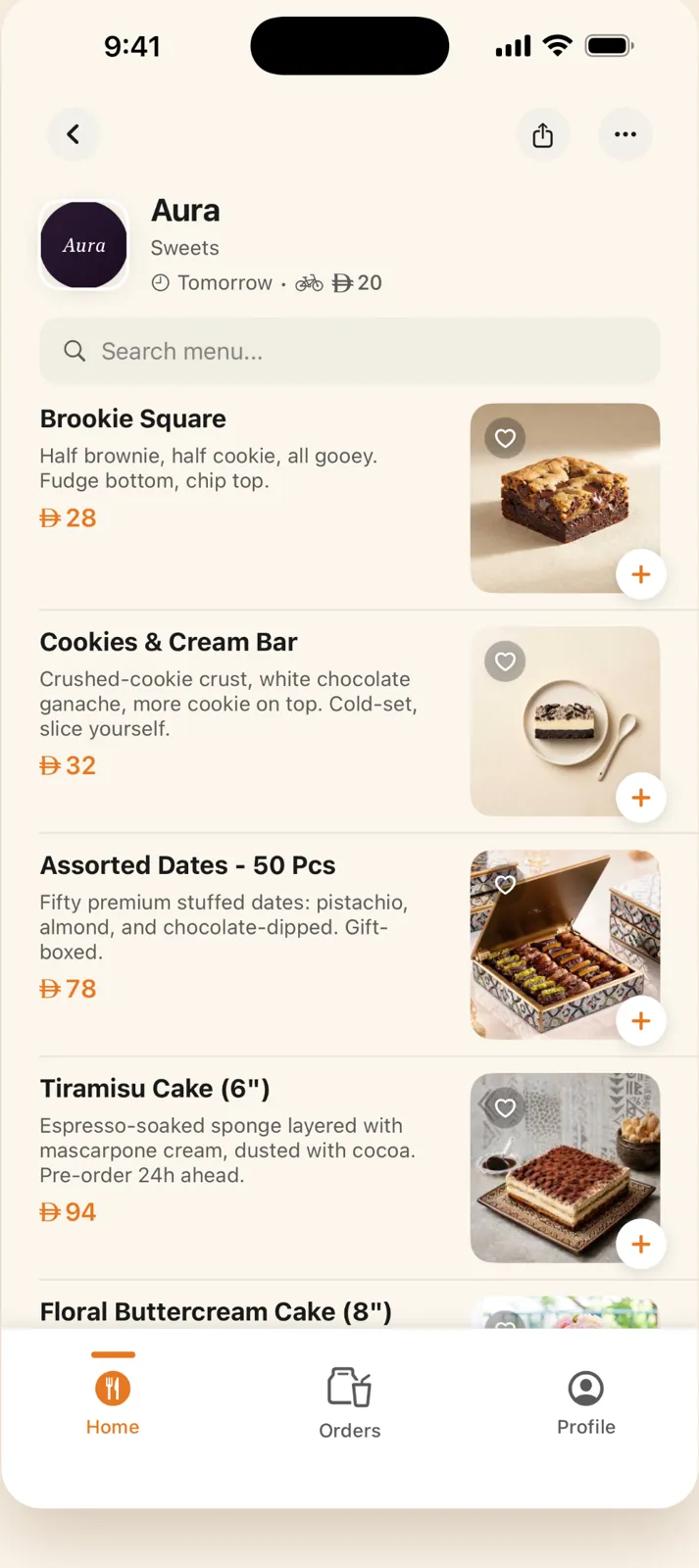
KLU is a UAE marketplace for home businesses: 5% commission on completed orders plus 2% card processing on card payments. The buyer chooses pickup or delivery, and pays the delivery fee at checkout.
| Option | Cost per order | Who pays | Cash on delivery | Distance | Food safety duty |
|---|---|---|---|---|---|
| Pickup | AED 0 | Nobody | Cash in hand | Buyer travels to you | Yours until handover |
| Self-delivery | Fuel and time; no published rate | You, or you add it to the price | Yes, you collect | As far as you will drive | Yours: high-risk food at 5°C or colder, or 60°C or hotter |
| On-demand courier | AED 17.36 to AED 35 published (Jeebly, Quiqup) | You book and pay | Quiqup 2.5% of value collected; Shipa lists cash-on-demand, fee unpublished | Quiqup 4-hour: 22 km then AED 1 per km; next day any emirate | Yours: check the provider meets DM rules |
| Marketplace (KLU) | Set by the platform | Buyer pays the delivery fee at checkout | Depends on the platform | Set by the platform | Yours for packing and temperature |
How much does courier delivery cost a home business per order?
Published figures as of 23 August 2026. Anything not listed has no published price we could find; get an in-app quote first.
Quiqup publishes a self-service schedule (version 26-07-15). A 4-hour same-emirate delivery by motorbike is AED 35 for up to 22 km plus AED 1 per extra km, Dubai city limits only. Next day within the same emirate or to another emirate is AED 22, and remote areas on a three-day service are AED 37. All rates exclude 5% VAT, returns are charged the full fee, and cash is reconciled every 2 weeks (Quiqup fee schedule).
Jeebly lists same-day anywhere in Dubai at AED 28.56 and next-day anywhere in the UAE at AED 17.36; the page does not say whether VAT is included, and individuals can book (Jeebly parcel delivery).
Shipa Delivery accepts anyone and runs same day from Dubai to Dubai, Abu Dhabi, Sharjah and Ajman, with no published prices (Shipa Delivery FAQ).
Careem Box publishes no price; the page directs you into the Careem app to book (Careem Box). Its 2017 launch minimum of AED 20 (TahawulTech, 23 May 2017) cannot be assumed current. We could not find a published Aramex rate card for small senders; get a quote on aramex.com or in its app.
Cash on delivery
Quiqup charges 2.5% of the value collected on every cash and card-on-delivery transaction (Quiqup fee schedule). Shipa lists a cash-on-demand option but publishes no fee; confirm with Shipa before promising it to buyers (Shipa Delivery FAQ). Careem Box shows no cash collection feature. With Quiqup a return costs the full fee, so a buyer who does not answer the door costs you twice.
What are the food transport rules for deliveries in Dubai and Abu Dhabi?
If you sell food, these rules apply whether you drive, book a courier or use a platform.
Dubai
Dubai Municipality's Food Code is the rule to work to, in the 2013 edition the municipality still links for food traders. High-risk and perishable foods that need temperature control "shall be transported, stored or distributed in equipment that consistently maintains those temperature controls", at or below 5°C if cold or at or above 60°C if hot, and frozen food at minus 18°C (Dubai Municipality Food Code, section 3.6.2). An older municipality food safety page also allowed "another temperature approved by the Dubai Municipality as safe". Neither Food Code version we read contains that caveat, and the page it came from no longer loads, so ask the Food Safety Department before you rely on it (Dubai Municipality food safety practices, archived 2 December 2022). The municipality's delivery requirements, reproduced in the RTA manual, say delivery should not exceed half an hour, food must travel in closed containers with thermal preservation, hot and cold separated, in a box disinfected before loading; delivery vehicles need an annual Food Safety Department permit registered on Food Watch; and a business using a third-party courier must ensure it meets these requirements (RTA delivery services manual). Permits for selling food from home in Dubai are in the Dubai guide.
The Dubai Food Code 2.0, Final Draft of 12 July 2023, applies transport rules to cars and bikes, sets frozen food at minus 18°C, covers food businesses run from home, and requires allergen information before an online order is completed (Dubai Food Code 2.0 draft). Three cautions. It is stamped Final Draft and adoption as written is not confirmed. Nothing says whether the vehicle permit covers a private car. And we could not find it on a Dubai Municipality host at all: the municipality's own Food Code 2 page offers only a March 2020 Version 4 whose file is missing, and the Food Code linked from its current food traders page is the 2013 edition cited above. Treat 2.0 as a draft you have read, not as the rule in force.
The half-hour rule is stated inconsistently, and the municipality's own wording is the one to plan against. Its 2023 food transportation and delivery vehicles guidelines say food "should not be on transit in the vehicle for more than half an hour", then add that "the time could be extended if the temperature and quality of the food can be maintained using additional equipment capable of temperature control" (Dubai Municipality DM-FSD-GU63, 2023). The RTA manual states the half hour without that extension, and the Food Code 2.0 draft sets temperatures with no minute limit. Gulf News, reporting a March 2024 municipality advisory, describes the half hour as advice to order from nearby, and says cooked or chilled food should not sit out for more than two hours after receipt. We have not seen that advisory on a Dubai Municipality page, so treat the two-hour figure as the newspaper's account of it (Gulf News, 24 March 2024). Plan hot and chilled deliveries to land within 30 minutes. If you need longer runs, the municipality's own text points at proper temperature-controlled equipment rather than a blanket exemption, so get that in writing from Dubai Municipality before you promise it.
Abu Dhabi
ADAFSA's Code of Practice No. 29 of 2019 says home delivery must comply with ADAFSA requirements, items must arrive in good condition at a safe temperature, refrigerated food should be delivered as soon as possible with a maximum of 2 hours in the danger zone, and chilled or frozen food must stay at or below the required temperatures (ADAFSA Code of Practice 29). Permits are covered in the Abu Dhabi guide.
Other emirates
Rules for Sharjah, Ajman, Ras Al Khaimah, Fujairah and Umm Al Quwain were not sourced for this guide; ask your municipality's food control section. Wherever you are: insulated bag or hot box, hot and cold in separate sealed containers, and a short radius for anything hot or chilled.
How should a home business set its delivery policy?
A delivery policy is three numbers: a minimum order, a radius and delivery slots. Show them on your storefront.
Minimum order
Start from the courier cost. A next-day courier at AED 22 is 55% of an AED 40 basket and under 15% of an AED 150 one. Make your minimum the basket size where the fee stops feeling like a penalty, and offer pickup below it.
Radius
Match the radius to the product. Quiqup's 4-hour service includes 22 km, and a food delivery app sets its own delivery area. For hot or chilled food in Dubai, the half-hour guidance sets the limit. For shelf-stable goods such as cookies or soap, next-day to any emirate works.
Slots
Batch orders into windows. Next-day is cheaper than same-day at Quiqup and Jeebly. Publish a next-day cutoff and one or two pickup windows a day.
What KLU handles for you
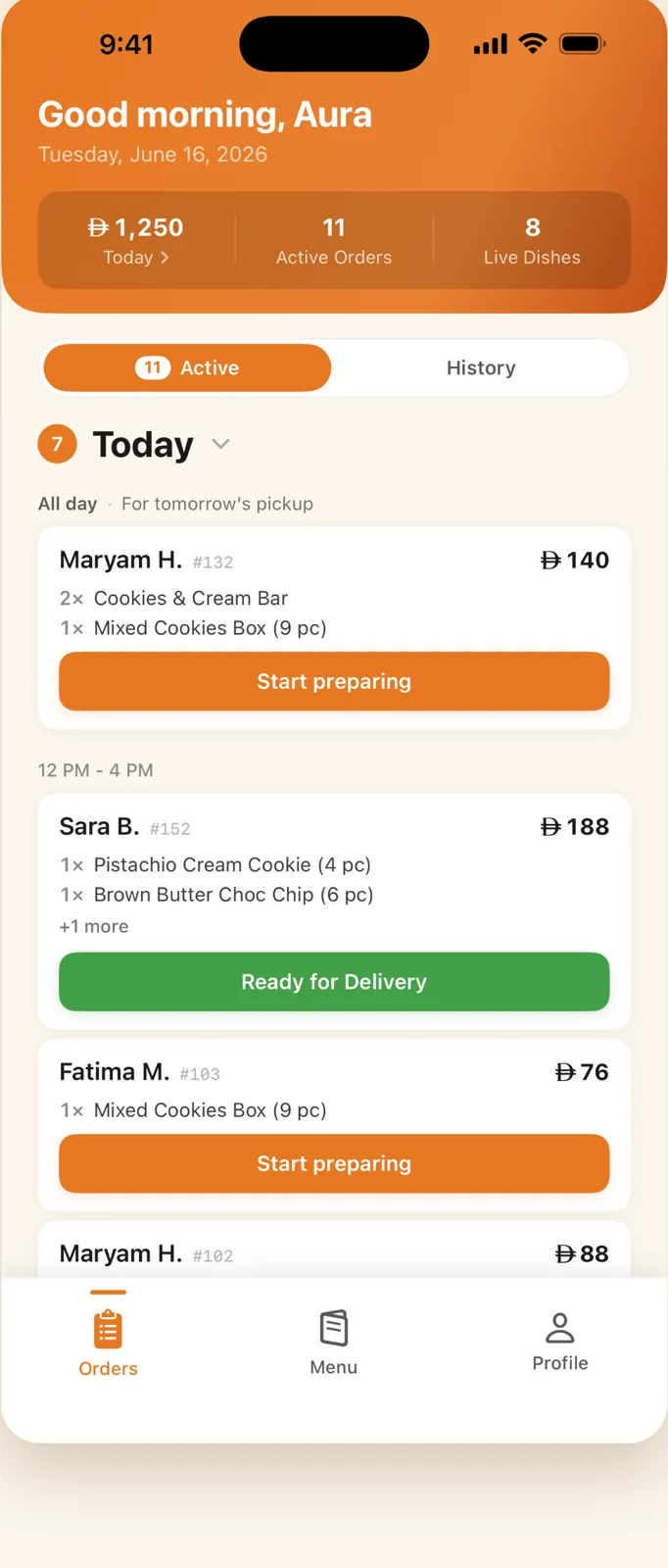
On KLU you list once and get a storefront link to share. Buyers order on the iOS app, the Android app or the link on the web; onboarding is in English and Arabic. They choose pickup or delivery, and the delivery fee is paid by the buyer at checkout. Joining is free, with no listing, subscription or setup fees, and payouts are weekly to a UAE bank account. Licensing stays your responsibility; the licence guide covers every emirate.
Frequently asked questions
Can I deliver my own orders in my private car?
No official rule clearly permits or prohibits it. The RTA manual regulates delivery establishments, and no source ties the federal AED 300 undesignated-purpose fine to goods delivery. Ask RTA or the Integrated Transport Centre and keep the written answer.
Can a courier collect cash on delivery for me?
Quiqup will, and charges 2.5% of the value collected. Shipa lists a cash-on-demand option but publishes no fee, so confirm it before promising it. Build the fee into your price.
How long can food be in transit in Dubai?
Dubai Municipality's 2023 delivery vehicle guidelines say food should not be in transit for more than half an hour, but allow longer where temperature and quality are held with equipment capable of temperature control. The Food Code sets the temperatures: at or below 5°C if cold, at or above 60°C if hot. Plan for 30 minutes unless you have that equipment and the municipality has confirmed it in writing.
Does KLU charge the seller for delivery?
The buyer pays the delivery fee at checkout. The seller pays 5% commission on completed orders plus 2% card processing on card payments, and nothing to join. More answers are on the FAQ page.
Sources
- RTA Technical Manual: delivery services through electronic platforms and smart apps
- Dubai Municipality Food Code, English V01, section 3.6.2 (document page)
- Dubai Municipality DM-FSD-GU63: Requirements for Food Transportation and Delivery Vehicles Guidelines, Food Safety Department, 2023
- Dubai Municipality Food Code 2.0, Final Draft 12 July 2023. Note the host: this PDF sits on a content-management CDN, not on a dm.gov.ae address, so a reader cannot confirm from the link alone that Dubai Municipality published it. We found no copy of Food Code 2.0 on an official municipality host, and the municipality's own Food Code 2 Draft page lists only a March 2020 Version 4 whose download is missing. The 2013 Food Code above is the version the municipality currently links for food traders.
- Dubai Municipality: Food Safety Practices, Retail Food Service, archived 2 December 2022. The foodsafe.ae page no longer loads, so this snapshot is the only version we could reach.
- ADAFSA Code of Practice No. 29 of 2019, Food Hygiene for Retail
- Quiqup Fees Schedule, Self-service 26-07-15
- Jeebly: Fast Parcel Delivery
- Shipa Delivery FAQ
- Careem Box
- Food delivery order alert, Dubai Municipality, Gulf News, 24 March 2024
- New rules for delivery riders in Dubai and Sharjah, Gulf News, 1 November 2025
- List of traffic offences and violations, Ministerial Resolution No. 178 of 2017 (Ministry of Interior), hosted on the UAE Government portal, linked from u.ae road safety
- Careem launches Box, TahawulTech, 23 May 2017
Last verified: 3 October 2026.