Where can a home business sell food online in the UAE?
Direct messages are the usual starting point. You post a photo on Instagram, someone asks the price, you agree a time, they transfer the money or pay cash at the door. Nothing to sign up for, nothing to pay, and the buyer is talking to you, not to a brand.
The other three exist because direct messages stop scaling. A marketplace lists you next to other businesses and handles the ordering. Your own website gives you a shop you control. A food delivery app puts you in front of a very large audience and takes a cut you cannot see in advance. Many sellers combine two routes: one that brings new buyers, and one they own outright.
What the four routes cost
| Route | What you pay | Who brings buyers | Who takes payment | Who delivers | What you own after a year |
|---|---|---|---|---|---|
| Direct messages (Instagram, WhatsApp) | Nothing to post. A UAE payment link costs from 2.6% plus AED 1 per payment | You, from your own following | You, by link, transfer or cash | You, or a courier you book | Followers and a chat history. No order record |
| Your own website (Shopify, Squarespace, Wix, Salla, Zid) | Subscription from about USD 19 a month, plus card fees from 2.5%, plus a platform fee on some plans | You. A new site arrives with no traffic | Your own gateway | You, or a courier you book | The site, the domain, the customer list |
| Marketplace (KLU) | Free to join. No listing, subscription or setup fee. 5% commission on completed orders plus 2% card processing | Buyers browse the listings, and you share your storefront link | The marketplace, paid out to your UAE bank account weekly | Pickup or delivery, with the buyer paying the delivery fee at checkout | A storefront link |
| Food delivery app (Talabat, Deliveroo, Careem) | A commission that no UAE platform publishes | The app | The app. Talabat pays 45 days after you go live, then every 2 weeks | The app's riders, within a 15 minute drive for Talabat | Very little. The app owns the customer |
Direct messages: free, personal, and hard to grow
What it actually costs
Posting costs nothing. Taking money is where fees start. Ziina charges 2.6% plus AED 1 per payment, 1.5% more on international cards, and nothing to receive; cash-outs are free today and move to AED 1 from 2 September 2026. Stripe charges 2.9% plus AED 1.00 on domestic cards, 1% more on international cards, 1% more again if the currency is converted, and AED 60.00 for every dispute you receive. Telr is priced upside down for small sellers: its entry plan is AED 349 a month with no per-transaction percentage, which costs more than a percentage would until your volume is high. All Telr fees carry 5% VAT.
Comparing gateways properly is not possible here. PayTabs publishes Saudi figures only, Tap has no UAE pricing page, and Network International publishes no merchant rate card. You must enter a sales conversation to learn the price.
Where it stops working
You are the order system. Every request is retyped by hand, prices live in your head, and two people can book the last tray of the day. There is no record to reconcile at month end, which matters because UAE rules require an online seller to issue a clear digital invoice for every transaction. WhatsApp is fine as the conversation, but it is not a checkout, and Meta's AED rates are published only as downloadable rate cards rather than on the pricing page itself, so you have to open the file to price a campaign. AED became a WhatsApp billing currency for the UAE on 1 April 2026; the higher UAE marketing message rate is a separate change, effective 1 October 2025.
Your own website: you own it, and you do all the work
Shopify's UAE plans are quoted in USD: Basic USD 24 a month billed annually, or USD 32 month to month. Card rates start at 2.9% plus AED 1.00 on Basic and fall to 2.5% plus AED 1.00 on the top plan. Using a provider other than Shopify Payments adds 2% on Basic, though Shopify Payments supports the UAE, so that fee is avoidable. Squarespace is USD 25 a month billed monthly, or USD 228 a year, with a 2% store transaction fee on the entry plan and 0% higher up. Wix publishes USD reference prices only and states that the price and currency you see in the UAE will differ, so treat its figures as indicative. Salla and Zid serve this region but price in Saudi Riyals with no AED tier: Salla Basic is free with Plus at SAR 990 a year, and Zid starts free with Launch at SAR 99 a month.
The catch is not the subscription. It is that a website brings nobody. You pay a monthly fee for a shop on a street with no footfall, and the traffic still has to come from your Instagram, your broadcast list, or paid ads. In return you own everything: your prices, your customer list, your data. If your buyers already know your name, build the site. If they do not yet, build the demand first. Our note on pricing a home business covers how to carry fixed costs without quietly losing money on every order.
Marketplaces and food delivery apps: who brings the customers
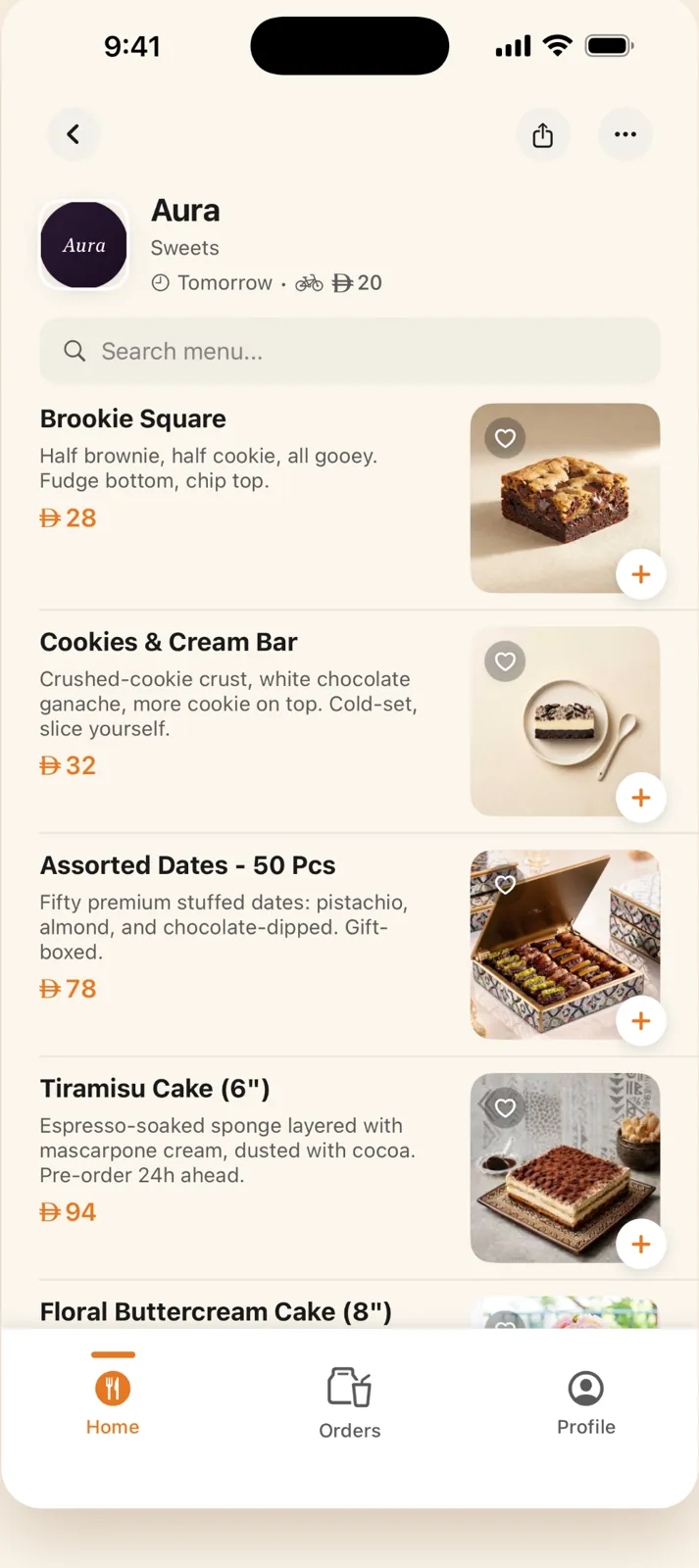
A marketplace does the part a website cannot: as a category, marketplaces gather buyers who are already browsing for something to eat, and you sit in those listings. On KLU it is free to join, with no listing, subscription or setup fees, and 5% commission on completed orders plus 2% card processing. Payouts go weekly to a UAE bank account. Buyers order on iOS, Android or the web, choose pickup or delivery with the delivery fee paid at checkout, and you get a storefront link to share anywhere. Onboarding is in English and Arabic. Delivery is worth planning before you list, and how delivery works for a home business sets out the options.
Food delivery apps are a different trade. They bring enormous reach and publish almost nothing. No UAE aggregator states a commission rate anywhere. Talabat confirms a commission exists but never gives a percentage; Deliveroo and Careem publish no partner fees or requirements at all; noon's seller properties refuse requests from outside the UAE, so we could not check them. The blended 39.1% of order value Talabat reported to investors for the second quarter of 2026 is not the restaurant commission: it mixes delivery fees, advertising and grocery. That filing does show a second cost nobody discusses. Partners funded a record 7.2% of order value in customer savings in the first half of 2026, a different period from the second quarter take rate.
There is also a plain eligibility problem. Talabat asks for a trade licence, Emirates ID and a tax certificate where applicable, and says nothing about whether a food business run from home qualifies. Deliveroo and Careem publish nothing at all. Ask them in writing before you build a menu around them, and ask for the commission rate in the same message.
The licence question sits under every route
This part is not about which platform you choose. The UAE Government states that you must have the appropriate licence to conduct eCommerce activities, and Federal Decree-Law No. 14 of 2023 explicitly covers selling through social media platforms, not just websites. Every eCommerce licence also needs a no objection certificate from the TDRA. That certificate is free and takes 2 working days; for social selling you submit your account names and links, and for a website you need a .ae national domain. A free zone licence does not reach the mainland without a distributor or extra approvals.
Two warnings. The official guidance has changed: the version of the government's eCommerce page published in January 2025 named the Dubai and Sharjah social-media licences and restricted them by nationality and residence, while the current version keeps only the links to those licensing services and drops every description and nationality restriction, without saying whether they were lifted or merely stopped being described. And no official source publishes a turnover threshold below which an occasional seller is exempt, nor a penalty schedule. Check the current rule with your emirate's Department of Economic Development and with the TDRA, and if you advertise on social media, ask the UAE Media Council whether its advertiser permit applies to you. Licensing is your responsibility as the business owner. Our guide to the home business licence in the UAE walks through the routes by emirate.
Frequently asked questions
Can I sell food on Instagram without a licence?
The UAE Government states the requirement without exception: you must have the appropriate licence to conduct eCommerce activities, and the 2023 law covers social media platforms directly. No official page publishes a turnover threshold for casual sellers, and none publishes penalties either. Ask your emirate's Department of Economic Development what applies at your scale.
Will a food delivery app accept a food business run from home?
No aggregator documents this. Talabat's published requirements list a trade licence, Emirates ID and a tax certificate where applicable, and mention no premises or food safety approval; Deliveroo and Careem publish no requirements at all. Ask each one in writing before you plan around them.
What commission do UAE delivery apps charge?
None of them publish it. No platform document we could find publishes a rate, so treat any percentage you see elsewhere as unverified. Talabat's investor materials report a blended take of order value that includes delivery fees and advertising, which is a different number from the commission a partner pays. Get the rate in writing before you sign.
Is my own website cheaper than a marketplace?
It depends on volume. A subscription is a fixed cost you pay in a quiet month, while a commission is charged only when you sell. A website also arrives with no buyers, so budget for whatever you spend to bring them.
Do I need a .ae domain name?
For a website, the TDRA no objection certificate requires a national .ae domain. If you are selling through social accounts instead, you submit the account names and links rather than a domain. The certificate itself is free and issued in 2 working days.
Can I use more than one route at the same time?
Yes, and combining two routes is often sensible: pair one channel that brings strangers with one you own outright. Keep one price list and one lead time across all of them, or you will spend the week reconciling your own promises.
Sources
- eCommerce, The Official Portal of the UAE Government
- eCommerce, UAE Government portal, archived January 2025 version
- NOC for Practising E-Activity, TDRA
- Shopify Pricing (UAE)
- Supported countries for Shopify Payments
- Squarespace Pricing
- Wix Pricing Plans
- Salla Plans
- Zid Pricing
- Stripe Pricing (UAE)
- Telr Pricing
- Ziina for Business
- Ziina Fees
- WhatsApp Business Platform Pricing
- WhatsApp Business Platform Pricing, Meta for Developers
- Talabat UAE Partner
- Talabat Q2 2026 Results Presentation
- Deliveroo Partners (UAE)
- Careem Food
- Careem Restaurant Partner Signup
- PayTabs Pricing
- Tap Payments UAE
Last verified: 24 August 2026.