Where do the first 10 orders actually come from?
From people who already know you. Not from strangers, not from an algorithm, not from an advert.
Open your phone and write down 30 names: family, neighbours, former colleagues, school parents, the women in your building group, the friend who always asks what you made. That list is your launch.
Message them one at a time. A broadcast to 30 people reads as an advert; a message written to one person gets an answer.
Keep the ask small, dated and priced: "I have started taking orders. I am baking on Saturday and have 6 boxes left at AED 65 each. Would you like one?" That is easy to answer. "Let me know if you ever want anything" is not.
Two rules stop it being awkward. Ask once, then stop. And never ask for a favour: you are telling them a thing exists that they can buy.
How do you make your offer easy to say yes to?
Most home businesses do not have a demand problem in the first month. They have a friction problem: someone wants to buy and cannot work out how.
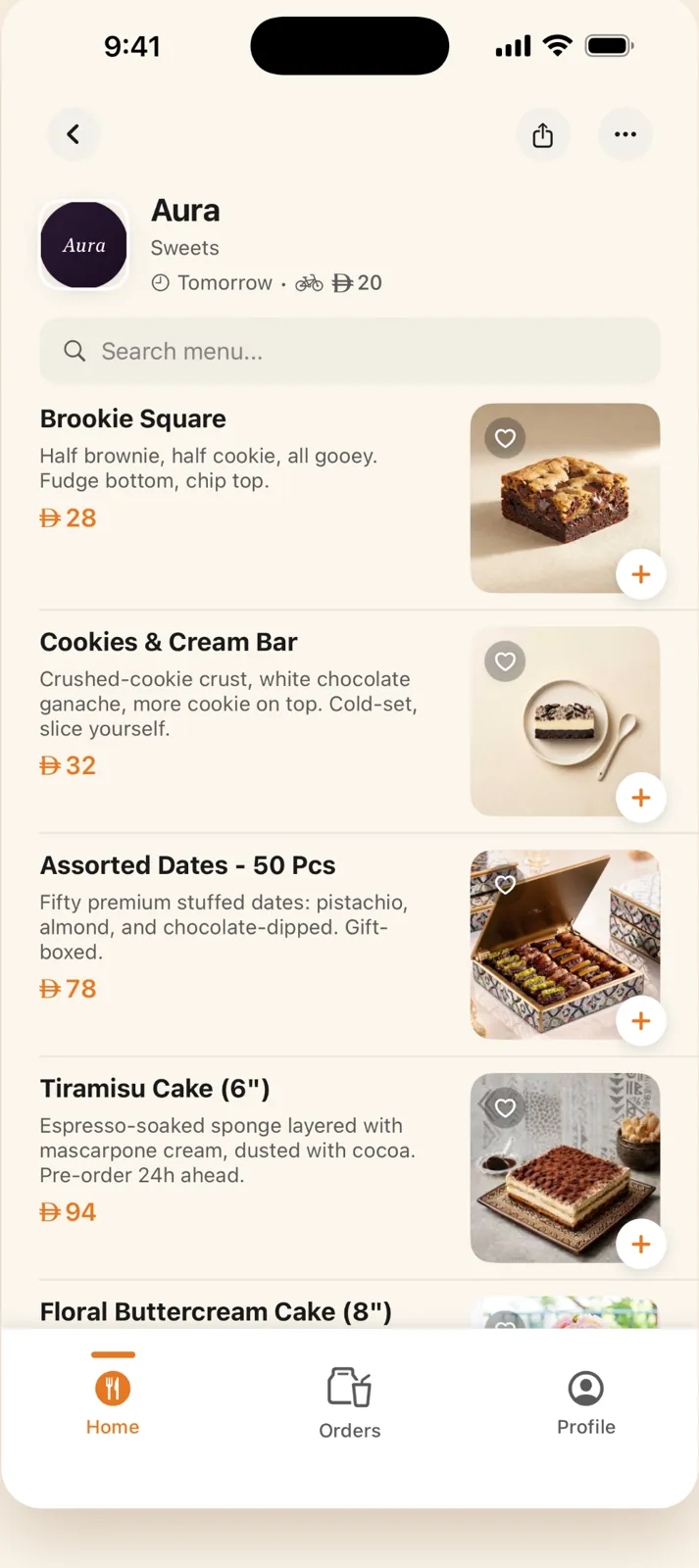
Publish a short menu with real prices
6 to 10 items, each with a price, portion size and lead time. Do not answer "DM for price": every message you force someone to send is a chance for them to change their mind. Work the numbers first: pricing your home business.
Use real photographs of your own products
One item, daylight, plain surface, taken on your phone. Stock images and heavy filters cost you orders: the buyer cannot tell what they are getting. Shoot each item once and reuse the photos everywhere.
Give one way to order that is not a chat thread
A chat thread has no record of what was agreed, no total, no address and no payment.
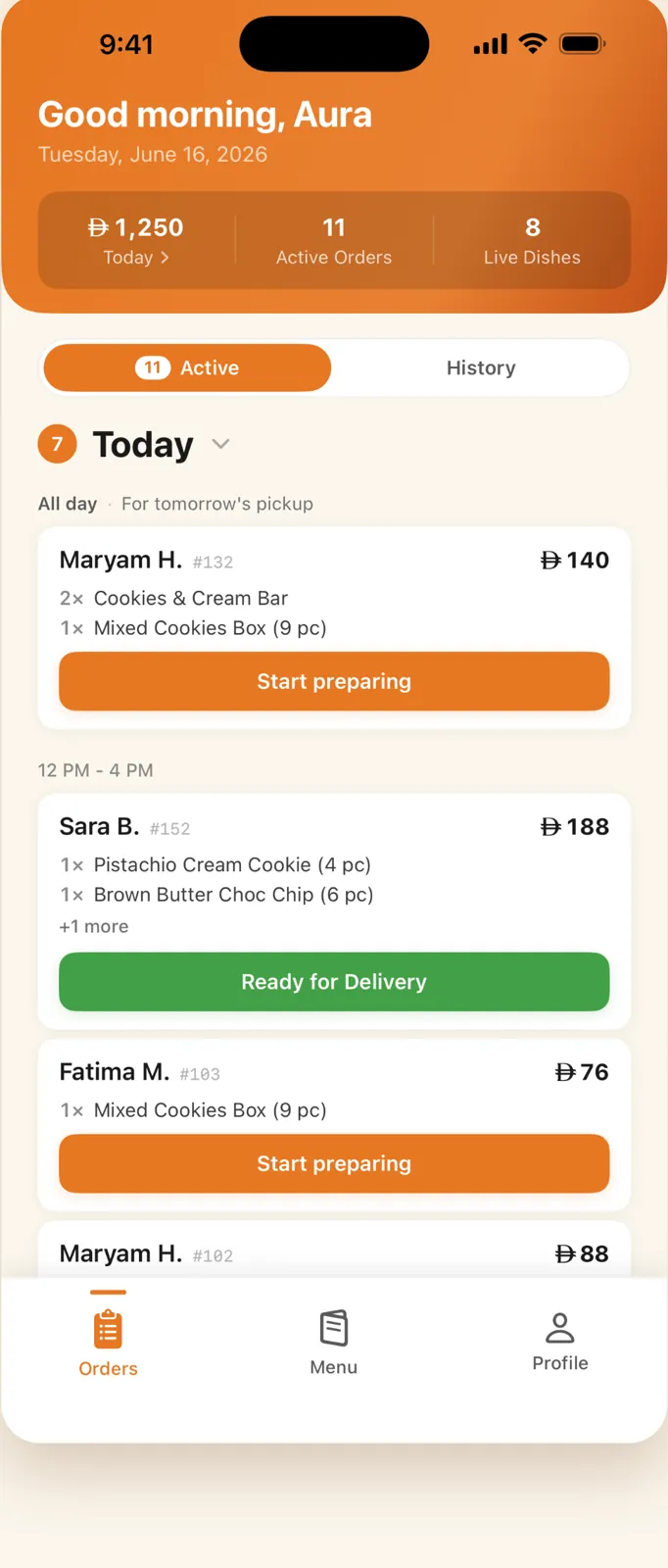
Send people to something that takes the order for you. The free WhatsApp Business app carries a catalogue, a cart, quick replies, labels, greeting and away messages, and a QR code or short link for your bio, across up to 10 linked devices. A marketplace listing does the same job and adds card processing and delivery the buyer pays for at checkout: KLU is free to join with no listing, subscription or setup fees, gives you a storefront link to share, takes orders on iOS, Android and the web, and pays out weekly to a UAE bank account, at 5% commission on completed orders plus 2% card processing. Compare the options in where to sell online in the UAE.
Say how it reaches them before they ask
Pickup or delivery, and what delivery costs. On KLU the buyer pays the delivery fee at checkout. See delivery for a home business.
Where do UAE home businesses find new customers?
| Channel | What it costs | Typical time to first result | What you keep afterwards |
|---|---|---|---|
| Word of mouth and WhatsApp groups | Free: the WhatsApp Business app is free | Days | Direct contacts and the strongest repeat rate |
| Free to post, ads cost what you set | 3 to 6 months of steady posting | Followers, but reach depends on the platform | |
| Community, building and school groups | Free, subject to the group's rules on selling | 1 to 4 weeks | A dense local cluster who reorder and refer |
| Community and seasonal markets | Stall fees, mostly unpublished. One Dubai weekly market publishes from AED 325 a day plus AED 125 registration | Same day, plus follow-up | Faces met, samples tasted, numbers collected |
| Marketplace listing | Free to join KLU: 5% commission on completed orders plus 2% card processing | Days to weeks | A storefront link, weekly payouts |
| Paid ads | Your budget, ongoing | Immediate, and it stops when you stop | Nothing, unless the click becomes a contact |
The timings in that third column are estimates from operator experience, not published figures.
Paid ads sit last for a reason: you own nothing at the end. Instagram and Facebook commerce rules also ban alcohol and ingestible supplements, and put compliance on the seller.
What works in the UAE that nobody writes about?
Ramadan and Eid gifting
Ramadan and Eid gifting is the busiest stretch of the year for many UAE food and craft businesses, and it is planned early. Publish a gifting list six weeks ahead with a fixed cut-off date, a minimum quantity and one or two box sizes. Take a deposit, and do not design custom boxes in the last week.
Corporate and majlis orders
One office order or one majlis tray can equal a week of individual orders and takes one delivery. Write a one-page order sheet with per-head pricing, minimum numbers, notice required and delivery windows, then send it to every workplace where you know someone. Ask for whoever books catering, not general enquiries.
Market season, October to May
One of Dubai's best known recurring weekend markets, The Ripe Market at Academy Park, has published a season of Saturdays and Sundays, 9am to 9pm, from 10 October 2026 to 2 May 2027. Indoor mall pop-ups run through the summer. Applications go in before the season starts, and no organiser publishes a deadline, so send them over the summer and ask when they close.
Most organisers publish no stall price: you apply and they quote. One long-running weekly Dubai makers' market is the exception, publishing a day rate from AED 325 plus AED 125 registration, with full credit at two weeks' notice, 50% at one week and nothing under a week, always as credit rather than cash.
Be clear about one thing: a market organiser's event licence covers the market, not you. That organiser tells vendors in writing to make their own enquiries, especially for food, and to hold their own e-permit if they sell online. Licensing is your responsibility, never the organiser's and never a platform's.
Government support you may already qualify for
Ajman's Reyada programme licenses UAE citizens to run an activity from home in Ajman, with priority for government exhibitions and three years' exemption from local fees. Eligibility is narrow: UAE citizen, resident in Ajman at an address with a Makani number, one licence, no staff. Ajman's Taziz programme, also UAE citizens only, with every owner, partner and manager on the licence required to be a UAE citizen, adds the same exhibition priority plus a 10% allocation of annual government contracts, at AED 1,000 a year for years 1 to 3 and AED 2,000 for years 4 and 5.
In Abu Dhabi, the Khalifa Fund membership programme for non-funded SMEs lists trade shows and exhibitions, though its funding is limited to Emirati-owned SMEs. Dubai Founders HQ runs an exhibitions and events service for Emirati founders. Sharjah's own sources contradict each other: the economic department's Ruwad page does not mention exhibitions, while the Ruwad Foundation's 2026 membership guide promises promotion space at events. Ask Ruwad what a member actually gets.
Why do repeat customers beat new ones?
A new customer costs you time, photos, messages and often a discount. A repeat customer costs you one message. If you have one hour a week for marketing, spend it on people who have already paid you once.
- Put a card with your storefront link and a QR code in every order.
- Message previous buyers by name when you have the thing they bought before. Label your contacts as orders come in so you can find them.
- Run a small, dated offer to past buyers only, once a month at most. Scarcity beats a permanent discount.
- Ask for a review or a photo on the day the order arrives.
The free app is enough for all of this: WhatsApp's paid business platform moved to per-message pricing on 1 July 2025, and the UAE marketing rate rose on 1 October 2025.
What are the rules if you pay someone to promote you?
Under Federal Decree-Law No. 55 of 2023 on Media Regulation, a person providing advertising or media content on social media, paid or unpaid, needs a permit. The individual advertiser permit is free for the first three years and AED 1,000 after that, issued in 3 working days, and requires a digital ID, passport, personal photo and a commercial licence, plus an awareness training programme. The three-year exemption sits in Cabinet Resolution No. 41 of 2025, Article 5.
The penalties are published. Posting advertising content without a permit: written warning, then AED 20,000, then AED 50,000. Breaching the advertising controls, which include disclosing clearly whether there is any payment or commercial relationship behind a post: AED 20,000, then AED 50,000.
Food matters here. Advertisements relating to foodstuffs require prior approval of the concerned authority. The penalty schedule does not single out food: an ad lacking a required approval carries AED 10,000, and a breach of the advertising controls AED 20,000. No official source names which authority a home food business should ask. Our advertiser permit guide covers this in full, including the exemption for posting your own products.
Two honest gaps. No official source says whether a business that pays an unpermitted creator is itself liable, though the law binds whoever is responsible for the activity and covers establishments as well as media companies. And the regulator is mid-transition: the National Media Authority holds the mandate under Federal Decree-Law No. 11 of 2025, while the fee and penalty resolutions still name the Media Council. Confirm the current rule and fee with them before you apply.
Practically: ask any creator you pay to confirm a valid permit and to label the post as advertising, and keep it in writing. A visiting non-resident creator needs a separate permit costing AED 500, valid three months and extendable to six, filed through a UAE-licensed advertising agency.
Frequently asked questions
How do I ask people I know to buy without it being awkward?
Make it a specific, dated, priced offer to one person rather than a general request for support. Say what you are making, when, how many are left and what it costs, then ask once and accept a no gracefully. The awkwardness comes from vagueness, not from selling.
Do I need a permit to post pictures of my own products?
Not from your personal account. The National Media Authority's permit page exempts individuals advertising their own products, or those of a company they own, via their personal accounts. It says nothing about a separate brand account, so ask the NMA if you post from one. Separately, advertisements relating to foodstuffs need prior approval of the concerned authority; ask your emirate's food safety authority whether that reaches an ordinary post.
How much does a market stall cost?
Most UAE organisers publish no price, so you apply and receive a quote. One weekly Dubai makers' market does publish: from AED 325 for a day, plus AED 125 registration and AED 50 of optional display items. Budget for stock and transport on top, and read the cancellation terms first.
What is the cheapest way to get a customer to buy again?
A named message to someone who already bought from you, sent when you have the thing they bought before. It costs nothing and converts better than any advert. Put a card with your storefront link in every box, so the reorder does not depend on them finding your chat.
Sources
- Individual advertiser permit, National Media Authority
- Visiting advertiser permit, National Media Authority
- FAQ, National Media Authority
- Federal Decree-Law No. 55 of 2023 on Media Regulation
- Cabinet Resolution No. 41 of 2025, Media Services Fees
- Cabinet Resolution No. 68 of 2024, Article 33 (PDF)
- Cabinet Resolution No. 42 of 2025, penalties schedule (PDF)
- Reyada Program, Ajman DED
- Taziz Program, Ajman DED
- Membership Programme, Khalifa Fund
- Exhibitions and events, Dubai Founders HQ
- Ruwad, Sharjah SEDD
- Ruwad Membership Guide 2026 (PDF)
- WhatsApp Business App Features
- WhatsApp Business Platform pricing, Meta
- Instagram for Business, Meta
- Commerce Policies, Meta
- The Ripe Market, Academy Park Dubai
- Vendor Information, ARTE The Makers' Market
Last verified: 25 August 2026.