Which home business licence covers food in Abu Dhabi?
No single licence covers this. The licence comes from the Department of Economic Development (ADDED); permission to prepare food at your address comes from the Abu Dhabi Agriculture and Food Safety Authority (ADAFSA). You need both, in that order. ADAFSA's guide names two ADDED licences: Tajer Abu Dhabi and Mubdiah.
Tajer Abu Dhabi. An economic licence for specific activities with no establishment site. You apply on TAMM with UAE Pass, no documents. Valid 1 year, renewable, and renewable without a location for the first 3 years only. Check the current age condition on TAMM before you apply.
Mubdiah (Mobdea). A licence for Emirati women dating from 2005, under which the home stays primarily residential (ADBWC). You must be a UAE national woman living in Abu Dhabi, at least 21, with preliminary approval from the Abu Dhabi Businesswomen Council, your husband's or guardian's approval, and your landlord's if you rent. Valid 1 renewable year (ADBWC), with no worker sponsorship (TAMM). ADBWC allows one activity per licence; ADRA says up to 2 similar ones (ADRA).
Neither licence lets you cook on its own. TAMM lists "approvals of other entities, if required" as a step; for food that means ADAFSA. Practice Guide No. 5 of 2024 requires the ADDED licence first, then the No-Objection Certificate before you start, and has a section confirming Tajer and Mubdiah holders can prepare food at home once its conditions are met (ADAFSA Guide 5/2024, p.23).
For other emirates, see Home business licence in the UAE and selling food from home in Dubai.
Who can hold one: Emiratis, GCC nationals or expats?
The official sources disagree here.
Mubdiah is clear: female UAE nationals residing in Abu Dhabi only (ADRA).
Tajer Abu Dhabi is not:
- ADRA, the registration authority under ADDED, says Tajer is "open to UAE Nationals, UAE Residents and GCC Nationals", via one-person companies for Emiratis or GCC nationals and "limited liability companies owned by residents in partnership with Emiratis" (ADRA).
- ADDED's licensing page says it is issued "to UAE citizens and residents" (ADDED).
- TAMM's service list tags Tajer and Mobdea as "Emirati" only, while Commercial and Freelancer licences are tagged "Emirati" and "Expat" (TAMM service list).
Then ADAFSA. In 2021 it listed UAE citizenship as a basic NOC requirement (Al Ittihad, 2021). Its 2024 guide lists 11 requirements and says nothing about nationality.
In practice:
- Emirati woman: both routes. Emirati man: Tajer only, because Mubdiah is "available to female nationals of the UAE, residing in Abu Dhabi" (ADRA).
- GCC national: ADRA opens Tajer to you through a one-person company (ADRA), and ADDED's 2018 expansion allowed an establishment for Emiratis and GCC nationals (WAM, 2018). ADAFSA's 2021 statement limited the NOC to citizens and its 2024 guide is silent, so get written confirmation before you fit out a space.
- Expat resident: the sources split. ADRA describes the resident route as an LLC with an Emirati partner (ADRA); ADDED's page says only "citizens and residents" (ADDED), as did WAM in 2018 (WAM, 2018), and ADRA elsewhere lists three legal forms, Establishment, Sole Proprietorship and Limited Liability Company, with no nationality split. ADAFSA's last public statement limited the NOC to citizens. Ask ADRA about the licence and ADAFSA about the NOC in writing before you spend anything.
How much does the licence cost?
| Licence | Who | Government fees | Validity | Where |
|---|---|---|---|---|
| Tajer Abu Dhabi | Emirati or GCC sole proprietor; residents via an LLC with an Emirati partner per ADRA, while ADDED says "citizens and residents" | AED 790 organisational entities + AED 10 economic register + AED 315 ICP establishment card + AED 50 Abu Dhabi Chamber + AED 10 issuance; AED 100 per activity after 6 | 1 year, renewable; no location needed for the first 3 years | TAMM |
| Mubdiah (Mobdea) | Emirati women 21+ living in Abu Dhabi | AED 790 organisational entities + AED 10 economic register + AED 300 Abu Dhabi Chamber + AED 10 issuance; AED 100 per activity after 2, and ADBWC allows one activity per licence | 1 year, renewable | TAMM after ADBWC approval |
| ADAFSA NOC for your address | Holders of either licence | No published fee | Not published; a change of activity or address needs fresh approval (ADAFSA Guide 5/2024) | ADAFSA customer service or the ADAFSA app (Al Ittihad, 2021) |
Three notes.
- Tajer line items on TAMM's English page add up to AED 1,175 (TAMM). Trust the figure shown at payment.
- ADRA puts Tajer at AED 790 to AED 5,500: the basic AED 790 covers 6 of about 1,200 activities, each extra one AED 100 (ADRA).
- For Mubdiah, ADRA quotes a basic AED 860 covering 2 investor-selected activities, with each additional activity AED 100 (ADRA). In August 2020 ADDED announced Emirati women were exempt from Mubdiah issuance and renewal fees under a Civil Defence decision (WAM). TAMM and ADRA still list ADDED and Chamber fees, so check the current figure on TAMM.
We found no published ADAFSA fee for the NOC, the inspection or the training; ask ADAFSA customer service to confirm (ADAFSA). The TAMM NOC service priced at AED 200 to AED 1,000 per activity is for free zone establishments, not homes (TAMM).
What does ADAFSA require before you can prepare food at home?
ADAFSA publishes the guide in Arabic only. Its Tajer and Mubdiah section lists 11 requirements (ADAFSA Guide 5/2024, p.23). Grouped into five steps:
Step 1: choose your food activity and get the ADDED licence
ADAFSA's 2021 list of activities permitted from home under Tajer Abu Dhabi: banquets, sweets, spices, popular dishes, pickles, snacks, and hot and cold drinks. Under Mubdiah: animal ghee, retail dairy, dates, pickles, pastries, bread and bakery products, sweets, popular dishes, and hot and cold drinks (Al Ittihad, 2021). That list is from 2021, so confirm yours with ADAFSA. ADBWC lists 44 Mubdiah activities (ADBWC), ADRA approximately 50 (ADRA); check the list on TAMM when you apply.
Step 2: set up a separate preparation space with its own entrance
You need a separate, dedicated food preparation space within the house (not the family one), with its own entrance apart from the home's main entrance, meeting ADAFSA Board Chairman Decision No. 6 of 2020, the Food Health System (ADAFSA). You may not alter the residence or turn it into a sales outlet, or change activity or address without going back to the authorities first (ADAFSA Guide 5/2024). Inspectors look for easy-to-clean non-slip surfaces, self-closing doors, insect screens, toilets outside it, a pest-control contract, plus protective clothing, gloves and head covers (Al Ittihad, 2021).
Step 3: complete the food safety training
The Essential Food Safety Training (EFST) is mandatory for every food handler in Abu Dhabi under Food Law No. 2 of 2008 and Resolution No. 6 of 2020 (Abu Dhabi Media Office). Everyone working in the business must be trained, and you follow ADAFSA's Salamat Zadna practices.
Step 4: request the NOC and pass the inspection
Request the NOC through ADAFSA customer service or the app. ADAFSA books an inspection, and only after approval can you sell (Al Ittihad, 2021). You and the owner both sign an undertaking allowing inspectors in, and any vehicle you use to transport food must be approved for it (ADAFSA Guide 5/2024).
Step 5: label every product and keep records
Every label needs the product name, a full ingredient list including allergens such as nuts, country of origin, usage and storage instructions, and expiry dates. Keep the NOC, licence, raw material invoices, Salamat Zadna records, training certificates and fridge temperature logs ready for inspection (Al Ittihad, 2021).
Does the same process apply in Al Ain and Al Dhafra?
The published evidence points that way. Mubdiah is issued by the DED in Abu Dhabi and Al Ain (ADBWC). On the last published split, August 2021, Al Ain led: 350 productive families held licences and NOCs, 237 in Al Ain, 106 in Abu Dhabi and 7 in Al Dhafra, so all three regions were already covered (Al Ittihad, 2021).
In May 2026 ADDED launched the Entrepreneurial Families Initiative in Al Ain with Khalifa Fund and others: workshops on set-up and licensing, then e-commerce and financial training (Abu Dhabi Media Office).
How does a home business start selling once the NOC is issued?
You cannot turn the home into a shop, and Mubdiah prohibits retail sale there (ADBWC). ADAFSA's 2021 guidance allows sales through productive family shops, other outlets and e-commerce, including delivery (Al Ittihad, 2021).
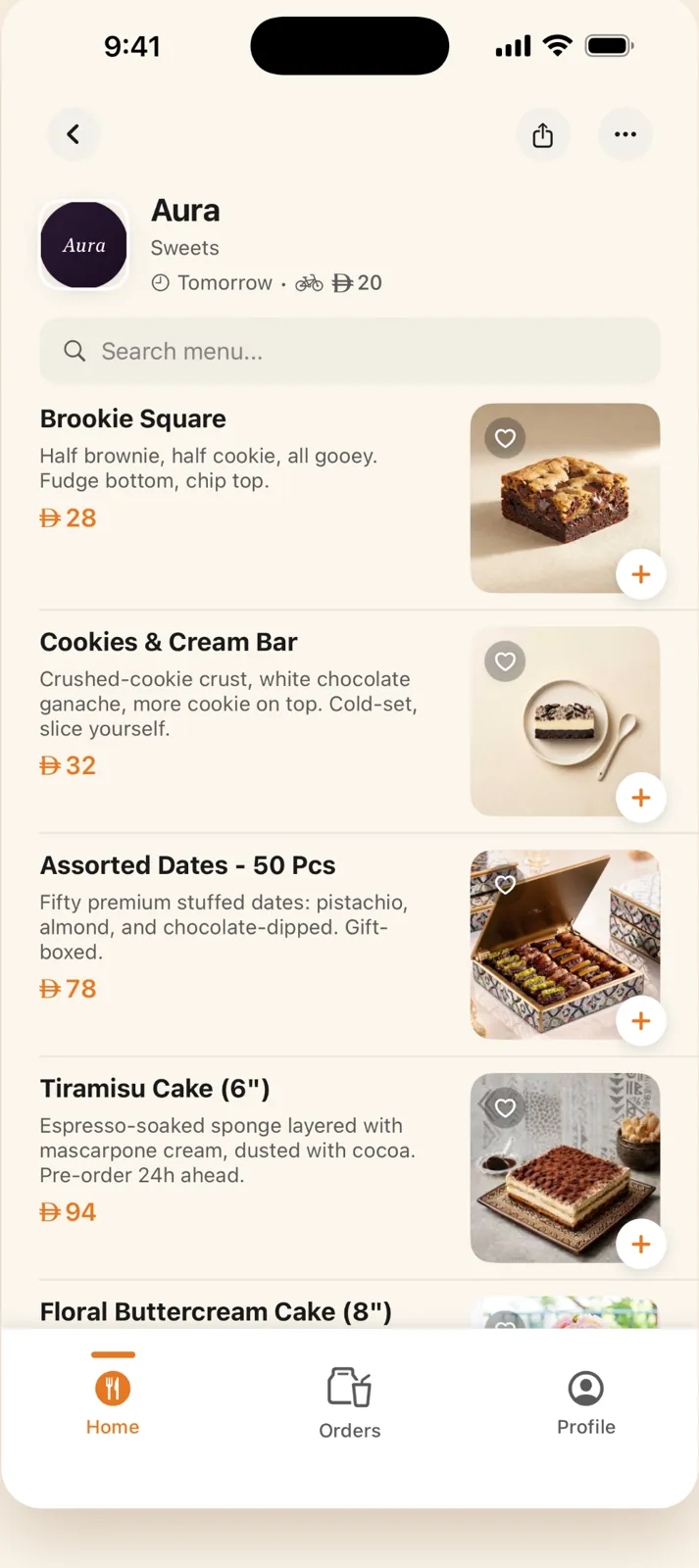
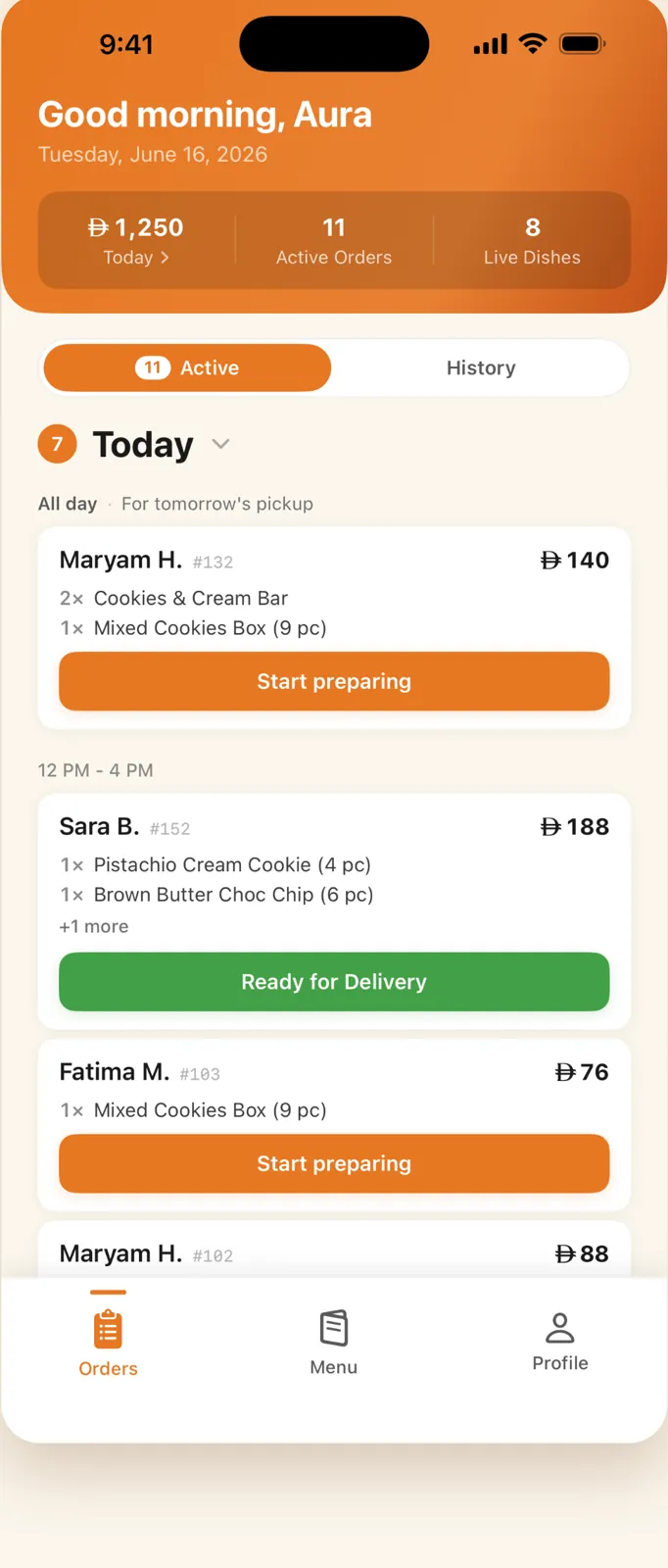
What a buyer should land on is a business with a name, a menu and a way to order.
KLU is the UAE marketplace for home businesses: food, drinks, beauty and crafts. Joining is free: no listing, subscription or setup fees. You pay 5% commission on completed orders plus 2% card processing on card payments, and you are paid weekly to a UAE bank account. Buyers order from your storefront link or the iOS and Android apps, and choose pickup or delivery, with the buyer paying the delivery fee at checkout. Onboarding is in English and Arabic; the FAQ covers the rest.
Three things first. Licence, training, fit-out and labels are real costs, so build them into every price (How to price cakes and food as a home business in the UAE). Approved food transport is an ADAFSA condition, so read Home business delivery in the UAE first. And VAT registration is mandatory once taxable supplies and imports pass AED 375,000, voluntary from AED 187,500 (Federal Tax Authority).
Frequently asked questions
Can you sell food from home in Abu Dhabi without a licence?
No. ADAFSA permits no activity before the NOC is issued, and the NOC needs an ADDED licence first (Al Ittihad, 2021). Federally, any online selling needs a licence (u.ae).
Can you prepare orders in the space where you cook for your family?
No. You need a separate, dedicated food preparation space within the house, not the family one, with its own entrance (ADAFSA Guide 5/2024).
Can an expat get one in Abu Dhabi?
The published sources disagree. ADRA describes the resident route as an LLC with an Emirati partner (ADRA), and ADAFSA's last public statement limited the NOC to citizens (Al Ittihad, 2021). Confirm with ADRA and ADAFSA in writing.
Is the Mubdiah licence free?
ADDED announced an exemption for Emirati women from issuance and renewal fees in August 2020 (WAM). TAMM and ADRA still list ADDED and Chamber fees, and ADRA quotes a basic AED 860 (ADRA), so check TAMM before you apply.
Sources
- TAMM - Tajer Abu Dhabi licence
- TAMM - Mobdea licence
- TAMM - Economic licence list
- TAMM - NOC service (free zones)
- ADRA - Tajer Abu Dhabi
- ADRA - Mobdea
- ADDED - Licensing requirements
- ADAFSA - Practice Guide 5/2024 (Arabic)
- ADAFSA - Regulations
- ADAFSA - Authority home page
- ADBWC - Mubdiah programme
- ADBWC - Issuing Mubdiah
- ADBWC - Activities
- Media Office - EFST (16 March 2026)
- Media Office - Entrepreneurial Families (22 May 2026)
- WAM - Tajer expansion (29 July 2018)
- WAM - Mubdiah fee exemption (28 Aug 2020)
- FTA - VAT registration
- u.ae - eCommerce licensing
- Al Ittihad - 350 licences (25 Aug 2021, Arabic)
Last verified: 23 August 2026.