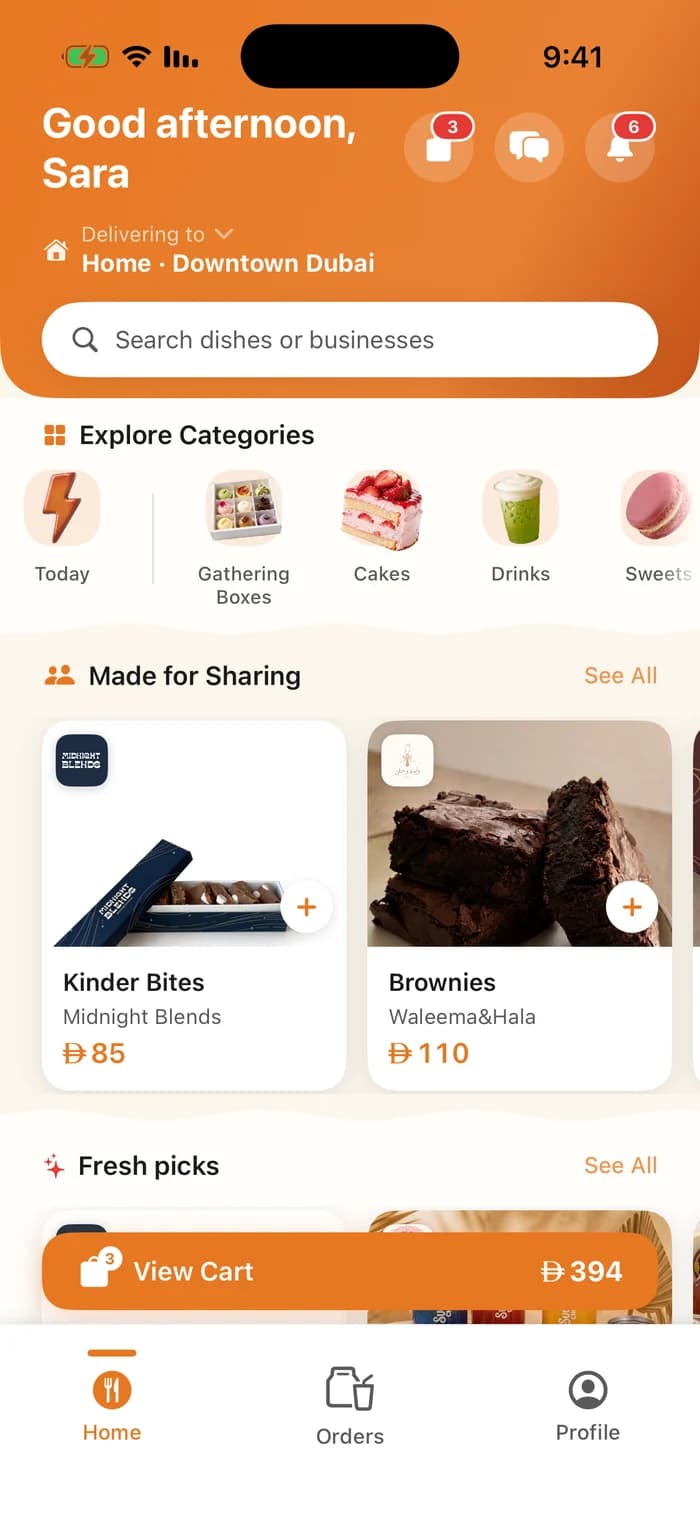
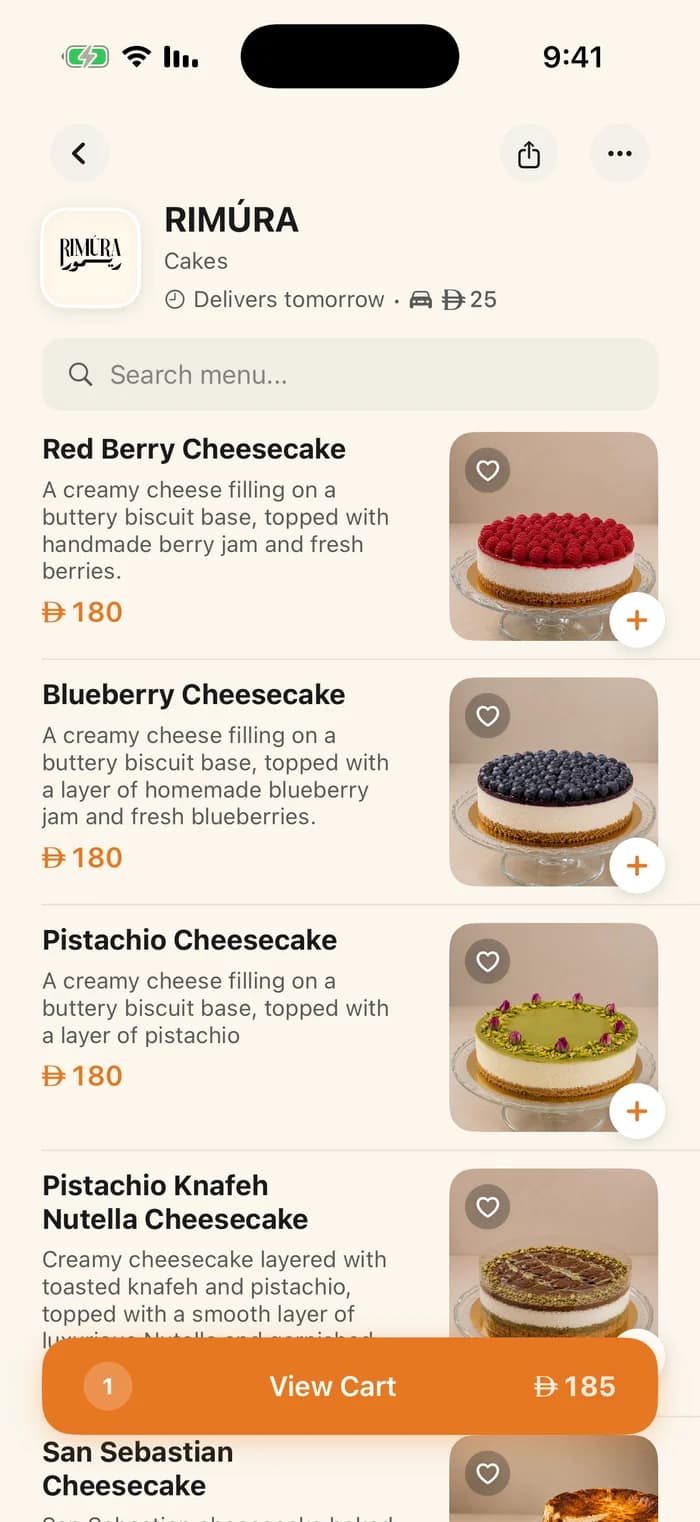
How ordering works anywhere in the country is covered in how to order from a home business in the UAE, and the Dubai guide runs these checks for Dubai. The two emirates do not work alike, and Abu Dhabi is the busier one: counting our own live directory on 26 September 2026, it carries 27 home businesses against Dubai's 13. Our directory of home businesses in Abu Dhabi lists each with what it makes and a link to its menu.
Can you check an Abu Dhabi home business licence yourself?
Partly, and only with a number the seller gives you. The UAE portal lists one Abu Dhabi service for verifying a business licence, "Enquire about economic licences", linked to TAMM (u.ae, inquire about licences, names and activities, updated 6 April 2026). That is Economic Licence Enquiry, or TAHAQAQ, run by the Department of Economic Development (TAMM, Economic Licence Enquiry). The page is client-rendered, so its fields cannot be read from the source, but the service publishes a configuration file naming every field and label (TAMM, TAHAQAQ service configuration). Three things in it matter to a buyer.
The form is one box and a radio button, not a directory search. The input takes a reference number, and the help text says what counts: "Please enter the respective reference number (i.e. License Number, Permit Number, E-Commerce Number, Memorandum of Association Number)." There is no trade name field, so a storefront name gets you nowhere and the number is the first thing to ask for.
What comes back is worth the asking: License Status, License Type, Expiry Date, Permit Expiry Date, License Activities and License Products. The activities line is the useful one, because a licence can be current and not carry the food activity the seller is trading on.
Then the catch. That same file marks the service's pages REQUIRES_LOGIN with a redirect to /login, the reference number page included, and the Wayback Machine captured that redirect on 21 September 2026. Expect a UAE PASS sign-in rather than allowing for one. Without it you cannot run the check at all, which leaves asking the seller for the licence and reading the number back to ADDED on 800 555.
What do Mubdiah and Tajer tell you about the seller?
Mubdiah, spelled Mobdea on official pages, is described by the Abu Dhabi Registration Authority as available to "female nationals of the UAE, residing in Abu Dhabi", with roughly 50 activities, a basic cost of AED 860 covering two activities of a similar nature, and no employees permitted (ADRA, Mobdea licence). Taken at its word, that is an Emirati woman resident in Abu Dhabi trading with no staff and no premises she must lease, since ADDED adds the licence "does not require a physical headquarters". Whether she prepares food at her own address is a separate question, answered by ADAFSA's guide rather than the licence. Tajer Abu Dhabi is the broader one: about 1,200 activities, AED 790 to AED 5,500, and no office required for the first three years (ADRA, Tajer Abu Dhabi licence).
The two official sites disagree about both, in public, today. On Tajer, ADRA's eligibility line is "Open to UAE Nationals, UAE Residents and GCC Nationals", while ADDED says the Abu Dhabi Trader Licence "is issued electronically for specific commercial activities to UAE citizens and residents" and leaves GCC nationals out (ADDED, licensing requirements, page updated 24 September 2026). On Mobdea, ADDED gives "44 activites" for "female citizens of the UAE" and says nothing about living in Abu Dhabi. None of that is a reason to doubt a seller, and all of it is a reason not to disqualify one over an eligibility rule you read on a blog, this one included. ADDED on 800 555 settles it.
What does ADAFSA require before a home business sells food?
The Abu Dhabi Agriculture and Food Safety Authority, ADAFSA, calls itself "the local authority in charge of agriculture, food safety, food security and biosecurity in the Emirate of Abu Dhabi" (ADAFSA, about). Law No. 7 of 2019 created it; food in the emirate runs on Law No. 2 of 2008, which is what ADAFSA cites when it shuts a business down. Guide No. 5 of 2024 sets out, on page 23, eleven requirements a Tajer or Mubdiah holder meets before preparing food at home (ADAFSA, Guide No. 5 of 2024, Arabic).
The seller works in a food preparation area separate from the household's own, with its own entrance apart from the home's main door, built to the emirate's hygiene system. The No-Objection Certificate has to come before trading begins, not after. Everyone handling food needs the food handler training and permit, the business applies Zadna food safety practices, and any vehicle carrying food has to be a permitted one. Applicant and property owner both sign an undertaking letting ADAFSA inspectors in. Two of the eleven are limits rather than requirements, and they explain why a home business will not invite you round: the residence cannot be altered or turned into a point of sale, and the activity and address cannot change without going back to the authorities. The seller's side is in selling food from home in Abu Dhabi.
There is a public tool for the food side, which Dubai does not have. ADAFSA's Certificates and Permits Validation page takes a single Certificate Number and asks for no sign-in (ADAFSA, certificates and permits validation, last updated 25 September 2026). What it will not tell you is what is inside it: ADAFSA publishes no list of the certificate types it covers, so whether a home business No-Objection Certificate can be validated there is unknown rather than settled. Ask for the number, try it, and if nothing comes back, call 800 555 before assuming the worst.
A rating is a different matter. Zadna Rating, ADAFSA's public platform, opens without a sign-in prompt and scores establishments excellent, very good, good or needs improvement. The rollout announced in 2023 was one that "will cover 6900 food establishments, including restaurants, cafes, bakeries, and catering establishments", to finish by that August (ADAFSA, Zadna evaluation). That list is open-ended rather than closed, and ADAFSA has never said home businesses are excluded while separately requiring them to apply Zadna practices, so no rating against a home business tells you nothing either way.
Who do you contact when an Abu Dhabi order goes wrong?
Abu Dhabi routes almost everything through one number. ADAFSA's own location records give the same phone and email for all 58 of its sites, 800 555 and contact@tamm.abudhabi (ADAFSA, contact), and ADDED publishes the same pair under a heading reading "Call Us Anytime" with opening hours of 8:00 am to 3:00 pm directly underneath (ADDED, contact us), so do not count on it late in the evening. What changes below is which authority picks up the problem, not which number you dial.
| What went wrong | Who handles it | How to reach them |
|---|---|---|
| Food made you ill, arrived spoiled, or looked mishandled | ADAFSA, for the whole emirate including Al Ain and Al Dhafra | 800 555, or contact@tamm.abudhabi. Working hours are given as 7 am to 3 pm |
| The licence looks wrong, expired, or does not match the business name | ADDED | Run the number through TAHAQAQ first, then 800 555 or contact@tamm.abudhabi |
| Refund refused, or the order was not what was described | ADDED Consumer Protection Section | 800 555, contact@tamm.abudhabi, or a visit to a TAMM centre, with your ID and the invoice |
| The seller is not licensed in Abu Dhabi, or nothing above fits | Ministry of Economy, as the national fallback | 800 1222 |
Three notes on that table, all from the authorities' own pages.
The food number is not where you would look for it. ADAFSA's contact page prints no number at all, because they load through a location picker, and its one link headed "Reporting violations" goes to the Abu Dhabi Accountability Authority, which handles government misconduct rather than a bad order. The number is real: ADAFSA prints it in its closure notices, asking the public to report "any violations detected in any food establishment, such as non-compliance or suspicion of food content, by calling the toll-free number for the Abu Dhabi Government, 800555" (ADAFSA closure notice, 18 April 2024). A notice from 2 October 2024 repeats it and names the offender by trade licence number, the same one you would type into TAHAQAQ, under Law No. 2 of 2008 (ADAFSA closure notice, 2 October 2024).
The refund row carries the sting. ADDED describes its consumer protection work as "receiving complaints from consumers and dealers regarding any untoward practices by commercial establishments that are licensed by ADDED" (ADDED, consumer protection, updated 24 September 2026). That is a description of scope rather than a rule shutting anyone out, but on that wording the door plainly opens for a licensed business, which is the argument for checking first.
Then there is what a complaint has to carry: your name and mobile number, your email if you have one, a copy of your identity document, and the purchase invoice or other proof of the transaction (DED Abu Dhabi, Consumer Protection Manual, hosted by ADRA). Keep the invoice; federal law backs you, since an online seller must "provide customers with a clear digital invoice for every transaction" under Federal Decree-Law No. 14 of 2023 (u.ae, eCommerce, updated 25 September 2026). Two copies of that manual disagree on the email, ADRA's 2020 one giving contact@tamm.abudhabi and the 2019 one on the UAE portal giving contact@abudhabi.ae (u.ae, consumer protection), and both still name the repealed Law No. 24 of 2006 while ADDED cites Federal Law No. 15 of 2020. Take the email from ADDED's current page.
Is it any different in Al Ain or Al Dhafra?
Not as far as anything published goes. ADAFSA is the food authority for the Emirate of Abu Dhabi as a whole, and we found no separate municipal food body for Al Ain or Al Dhafra and no rule that differs by region. Its location list names branch offices in both, two in Al Ain and an administration building in Al Dhafra, all on the same 800 555 and the same 7 am to 3 pm hours as the headquarters.
Volume is another matter. The last published count is from August 2021, when ADAFSA reported 350 home food licences across the emirate, 237 in Al Ain against 106 in Abu Dhabi and 7 in Al Dhafra, under what the authority calls productive families (Al Ittihad, 25 August 2021). Nothing newer has come from ADAFSA, the Abu Dhabi Media Office or the state news agency, so treat 350 as a 2021 figure, not today's.
Does Abu Dhabi limit how far a home business can deliver?
Nothing published sets a limit. On transport, ADAFSA's guide hands the question over rather than answering it: the operator "is bound by the Unified Guide for Food Transport", a federal document from the Ministry of Climate Change and Environment (MOCCAE, Unified Guide for Food Transport). Neither Guide No. 5 of 2024 nor anything on ADDED's or ADRA's sites sets a delivery radius, a time cap or a list of areas a home business may serve.
Dubai comes out the same way, so a seller in Khalifa City delivering to Al Ain is not doing anything irregular. The real question is the food, not the paperwork: how long the drive is, whether the item is meant to be eaten hot, whether it travels chilled. Ask the seller how they pack for the distance, because no authority has answered that for them.
Frequently asked questions
Can I check an Abu Dhabi home business licence before I order? Up to a point. The UAE portal points to one Abu Dhabi tool, Economic Licence Enquiry, or TAHAQAQ, on TAMM. It takes a reference number, meaning a licence, permit, e-commerce or memorandum number, so you have to get that number from the seller; there is no search by trade name. Its own configuration marks the pages as requiring a login, so expect a UAE PASS sign-in.
Is there one phone number for Abu Dhabi complaints? Effectively yes. ADAFSA and ADDED both publish 800 555 and contact@tamm.abudhabi, in Al Ain and Al Dhafra as well. Which authority handles your problem changes; the number does not. If the business is not licensed in Abu Dhabi at all, the national fallback is the Ministry of Economy on 800 1222.
What happens if the seller is not licensed and refuses a refund? ADDED describes its consumer protection remit as complaints about establishments licensed by ADDED, so on that wording an unlicensed seller may sit outside it. That is why the check belongs before the payment. If you are already there, try the Ministry of Economy on 800 1222.
Can I look up a home business's food safety score? ADAFSA's Zadna Rating platform opens without a sign-in prompt, but the 2023 rollout covered 6,900 food establishments "including restaurants, cafes, bakeries, and catering establishments". ADAFSA has never said home businesses are excluded either, so no score is not a red flag.
What should I keep in case something goes wrong? The invoice, above everything, plus the date and what was ordered. How ordering and records work on KLU is in the FAQ.
Sources
- u.ae, inquire about licences, names and activities
- TAMM, Economic Licence Enquiry (TAHAQAQ), with field labels read from the service's published configuration file
- ADAFSA, about the authority
- ADAFSA, certificates and permits validation
- ADAFSA, contact
- ADAFSA, Guide No. 5 of 2024 on licensing food establishments (Arabic, PDF)
- ADAFSA, Zadna food safety rating platform
- ADAFSA, closure notice naming 800555 for public reports (18 April 2024)
- ADAFSA, closure notice citing Law No. 2 of 2008 (2 October 2024)
- ADDED, consumer protection
- ADDED, licensing requirements
- ADDED, contact us
- ADRA, Tajer Abu Dhabi licence
- ADRA, Mobdea licence
- DED Abu Dhabi, Consumer Protection Manual (PDF, hosted by ADRA)
- u.ae, consumer protection
- u.ae, eCommerce and Federal Decree-Law No. 14 of 2023
- MOCCAE, Unified Guide for Food Transport (PDF)
- Al Ittihad, 350 home food licences in Abu Dhabi (25 August 2021, Arabic)
Last verified: 26 September 2026.